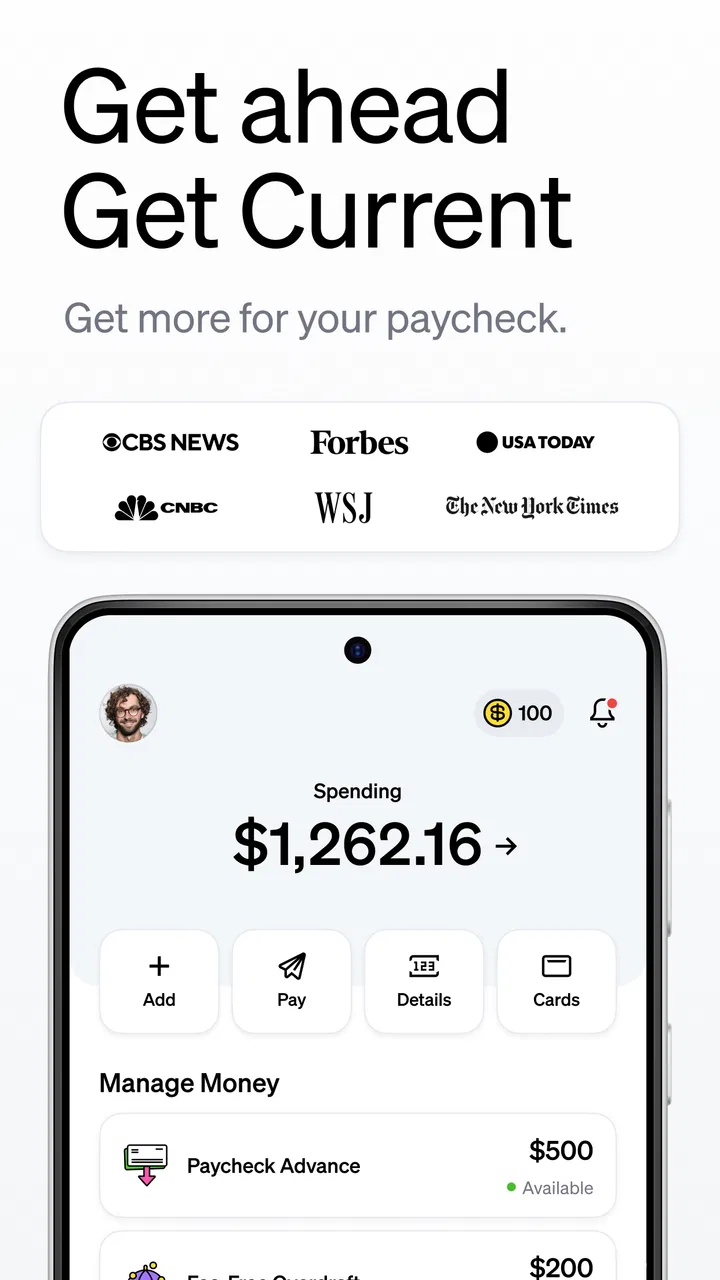
Current - Mobile Banking
- 4.4
- Rating
- 5.00M
- Installs
- Free
- Price

 Analysis by App-foxy
Managing money from a phone sounds effortless until a weak signal turns a simple payment into a question mark. I found that this is the most useful way to judge Current: not only by the screens it offers, but by how confidently I can use those screens while moving between home Wi-Fi, mobile data, crowded public places, and moments when the connection is unreliable. Current is a free finance app from Current, aimed at saving, spending, and getting paid through a mobile banking experience.
It has been available since May 5, 2017, and its presence is now substantial, with more than five million installs and an average rating of 4.5 from roughly 176 thousand ratings. Those figures do not replace personal testing, but they do suggest that the app has become a familiar option for people who want everyday banking tools close at hand. I reviewed it as an app for regular money tasks rather than as a complete replacement for every kind of financial service.
How Current feels when the connection matters
I find that connection reliability matters most at the handoff between deciding to act and checking what happened. In this section, I look at how I keep that handoff clear when a screen takes longer than expected, so a slow refresh does not turn into a duplicate attempt or a mistaken assumption. The same pause-and-verify habit also helps me decide which money tasks are better saved for a steadier moment.
You May Also Like

 Blood Strike: 2.5 Anniversary
Blood Strike’s Loadouts Turn Every Drop Into a Tactical Gamble
A close look at Blood Strike’s custom loadouts: how fast access to signature weapons reshapes its battle royale rhythm, rewards preparation, and narrows the gap between fights.

 Pandora - Music & Podcasts
Pandora’s Music Is Easy to Start, but Harder to Recover
Pandora’s strength is its low-effort path from a seed to a station. Its weak spot is how much confidence it asks you to place in connection, setup, and quiet recovery.

 8 Ball Pool
 Is Built on Rivalries, Rematches, and Routine
A close look at the rivalries, rematches, shared routines, and unanswered safety questions that turn a quick pool match into a persistent mobile community.

 Samsung Music
’s Quiet Strength Is Playing What You Already Own
Its reach comes less from spectacle than from dependable access to a personal library. That simplicity is both the app’s strongest retention engine and its ceiling.

 AccuWeather: Weather Radar
AccuWeather Review: A Quick, Clear Forecast for Everyday Decisions
For everyday plans, the best forecast is the one you can understand quickly. AccuWeather makes rain timing, radar, and local conditions easy to act on, with a few trade-offs.

 Hill Climb Racing
Why Hill Climb Racing Still Turns Crashes Into One More Run
A tiny car, a bumpy hill and one more upgrade: Hill Climb Racing keeps resurfacing because its simple chaos makes every near-miss feel personal.
More From Our News Desk



Why network-dependent moments deserve attention
The central lesson from using a mobile banking app is simple: the phone is only one part of the experience. Current can present a clean route to spending, saving, and receiving money, but account information and transaction activity are the kinds of details I want to see refreshed before I make a decision. When the network is slow, the practical problem is not just waiting. It is knowing whether an action has completed, whether the balance is current, or whether I should try again.
That makes connectivity especially important after a card purchase or transfer. I prefer to open the app once, allow the account view to load, and then avoid repeatedly tapping a button if the screen hesitates. Repeating an action during a poor connection is a bad habit in any financial app because the interface may be waiting for a response even when it looks inactive. My best advice is to treat a delayed confirmation as a reason to pause, not as an invitation to submit the same request several times.
Current works best when I use it as a live financial dashboard. A strong connection lets me check recent activity, review the money available for a purchase, and move through the app without guessing. A weak connection changes the experience into a verification exercise. I may still be able to open parts of the interface, but I would not rely on a stale-looking balance for an important decision. The app is most reassuring when the information has had time to refresh normally.
A realistic day with the app
Imagine leaving work and buying groceries before heading home. I use the app to check what has recently cleared and to make sure the planned purchase fits the money I expect to have available. In a busy store, the phone may switch between Wi-Fi and mobile data, and the signal can become inconsistent. If the app loads normally, the process is quick. If it does not, I finish the purchase using the payment method already available to me and wait for a reliable connection before investigating the activity screen.
That small change in behavior matters. I do not use a banking app’s delayed display as proof that a transaction failed, and I do not assume that an absent update means money has not moved. Current is useful here because it gives me a place to review the account afterward, but the quality of that review depends on the connection and on allowing the app to synchronize properly.
Using it in different mobile contexts
At home, Current feels easiest to evaluate. I can open it without rushing, check the account, and think about what I am seeing. In a commute, at a café, or while standing in a checkout line, the same task becomes more demanding. The app is designed for mobile access, but mobile access does not guarantee a dependable network. I found that the most comfortable routine is to do planning and review when I have a stable connection, then use the app on the move for quick checks rather than complicated money decisions.
This is also where the app’s focus becomes clear. Current is convenient for people who want spending and saving information close to their daily routine. It is less appealing to someone who prefers to do all banking from a desktop, keeps detailed financial records in a separate system, or needs a broad set of traditional banking tools in one place. A phone-first experience is a strength only if the user is comfortable making the phone part of the financial routine.
I would be particularly careful when using public or overloaded networks. Financial screens deserve the same attention as any other sensitive account activity, and I prefer a trusted connection for actions that change my money rather than merely viewing information. The app does not eliminate the need for sensible phone and network habits. A convenient interface cannot compensate for rushing through an unfamiliar connection.
What happens when something goes wrong
The most important recovery skill is separating an app problem from a transaction problem. If a page refuses to load, I first check whether other apps are also struggling, then I switch to a more reliable connection and reopen Current. I avoid clearing information or repeatedly reinstalling the app as a first response, because those steps can create extra sign-in friction without answering the original question.
If I have just attempted an action, I look for a clear account update after reconnecting rather than immediately trying again. I also keep the timing and approximate amount in mind so I can compare the refreshed activity with what I intended. This is a simple workflow, but it prevents the most common mistake in a slow mobile banking session: turning uncertainty into duplicate activity.
There is a trade-off here. A specialized banking app should make everyday money management feel direct, yet money is more sensitive than a normal social or shopping app. I would rather wait for a trustworthy update than receive a fast-looking screen that I have not had time to verify. Current earns credit for being approachable, but users still need patience when connectivity interrupts the normal flow.
Keeping mobile data use sensible
I do not think a banking app should be treated like a media app that constantly consumes data. My practical approach is to use Wi-Fi for longer reviews, account organization, and any session where I expect to move between several screens. On mobile data, I keep the task narrow: check what I need, confirm that the screen has refreshed, and close the app when finished.
That approach is useful for people with limited data plans, but it also improves concentration. A short session makes it easier to notice whether the balance or activity is current. I avoid refreshing again and again simply because I am curious. If the app is slow, the better response is usually to wait for a stronger connection instead of turning a single check into a long sequence of reloads.
Users should also remember that an app update can change how a familiar screen behaves. Current is currently at version 8.3.2 and requires Android 8.0 or later. I would keep the app updated through the normal device process, but I would not schedule a major account task around the exact moment an update is pending. On an older phone that meets the minimum system requirement, performance and network handling may feel less comfortable than on newer hardware.
Saving and spending in the same routine
The appeal of Current is that saving and spending can be considered together instead of living in completely separate habits. I can think about a purchase while also checking whether I am keeping money aside for a goal. That is more useful than a bare balance screen because it encourages me to view a transaction in context: not just “Can I pay?” but “Does this fit the way I planned to use my money?”
Still, I would not confuse a convenient app with a financial plan. Current can support a routine, but it does not make spending decisions automatically sensible. I would start with one clear purpose, such as separating money for a recurring expense or checking spending after a busy week. Once that routine feels reliable, the saving side becomes more meaningful than simply moving money around whenever the balance looks uncomfortable.
A less obvious benefit of this approach is that connectivity can become a deliberate boundary. If I review spending only when I have a stable connection and enough time to interpret the activity, I am less likely to make an impulsive decision based on incomplete information. That is not a special feature; it is a better workflow built around the way a mobile banking app actually behaves.
Getting paid and checking the result
Current also makes sense for someone who wants a mobile place to receive money and then manage it alongside spending and saving. The convenience is strongest when the user already handles most daily financial tasks from a phone. Instead of treating incoming money as an isolated event, I can check the account and decide how much belongs in ordinary spending and how much should remain set aside.
Connectivity matters again at the moment I expect money to appear. I would not rely on a slow screen as proof that a payment has not arrived. I would refresh later on a stable connection, review the activity, and keep any confirmation details available if I needed to investigate a delay. This habit is especially important for anyone using the app for time-sensitive household budgeting.
People who need elaborate payroll tools, business accounting, or a deep desktop workflow may find a mobile-first account too narrow. For personal use, however, the combination of getting paid, spending, and saving in one app is more coherent than juggling several unrelated services. The deciding factor is whether the app’s focused approach matches the user’s financial life.
Where it stands beside usual alternatives
Compared with a traditional bank’s mobile app, Current feels more centered on everyday phone use and straightforward money habits. A long-established bank may be the better choice for someone who wants a broad relationship with one institution, extensive account types, or a familiar desktop setup. Current is more attractive when the priority is quick access to spending, saving, and incoming money without making the experience feel like a branch translated onto a screen.
Compared with a budgeting app, the distinction is different. A budgeting app may be better for detailed categories, long-term analysis, and combining information from several accounts. Current is more direct for people who want to interact with the money in the account rather than study a separate financial report. I would choose a budgeting tool alongside it if detailed planning were important, not expect a focused mobile banking app to replace every planning method.
Compared with a payment-only service, Current has a broader personal finance role because saving and spending sit beside getting paid. A payment wallet can be quicker for a single purchase or person-to-person exchange, but it may not provide the same sense of an everyday account routine. The trade-off is that a broader app deserves more careful setup and review than a tool used only for sending one payment.
Who will appreciate the experience
I think Current is a good fit for people who already reach for their phone first when checking money. It suits a user who wants a free finance app, prefers a clear mobile routine, and values having spending, saving, and incoming money considered in one place. It can also work well for someone trying to develop more awareness around everyday purchases without starting with a complicated financial system.
The Everyone content rating makes it broadly approachable from an age-classification perspective, but that should not be mistaken for a promise that every financial situation will fit it. A young or inexperienced user still benefits from learning how balances, pending activity, and completed transactions differ. The app can make access easier; it cannot replace financial judgment.
I would skip it if reliable desktop access is essential, if the user needs advanced reporting, or if a weak connection is a normal part of the places where banking happens. I would also look elsewhere if the main goal is investment research, business bookkeeping, or a highly specialized account structure. Current is strongest when the problem is everyday mobile money management, not when the user wants one app to cover every financial category.
Small habits that make it more dependable
- Open the app on a trusted connection before making a decision based on the current balance.
- After a delayed action, reconnect and review activity before attempting the same action again.
- Use Wi-Fi for longer reviews and keep mobile-data sessions focused on one clear task.
- Keep a simple note of the intended amount and timing when a payment or incoming transfer matters.
- Update the app normally, but avoid beginning an important transaction while the phone is changing app versions.
These habits may sound cautious, but they are exactly what makes a connected banking app feel predictable. The app can reduce friction; it cannot remove the uncertainty created by a poor signal or an unrefreshed account view. I found that Current is at its best when I work with that reality instead of pretending the phone is always online.
My final view on Current
After using Current as a mobile finance tool, I see its main strength in focus. It brings saving, spending, and getting paid into a routine that feels natural for phone users, and its free price removes an obvious barrier to trying that routine. The app’s scale, with more than five million installs, and its 4.5 average from about 176 thousand ratings, also show that it has found a sizeable audience.
My reservation is not about the idea of mobile banking; it is about the moments when connectivity makes a financial screen ambiguous. Current is convenient when the account view loads properly, but I would not use any mobile banking app casually on an uncertain network. The user has to know when to wait, when to reconnect, and when a different kind of financial tool would be more suitable.
My recommendation is straightforward: choose Current if you want a focused, phone-centered way to manage everyday money and you are comfortable building careful connection habits around it. Choose a traditional bank app or a dedicated budgeting service instead if you need broader account services, deeper analysis, or a dependable desktop-first workflow. For the right user, Current makes daily money checks feel less formal and more manageable; its best results come from pairing that convenience with a little patience whenever the network gets in the way.
FAQs for Current - Mobile Banking
01What features does Current Mobile Banking offer?
Current Mobile Banking provides a range of features including instant notifications, budgeting tools, and fee-free overdrafts. Users can also benefit from fast direct deposits, seamless money transfers, and savings pods to organize their funds effectively. The app aims to streamline financial management with user-friendly tools and a modern interface.
02Is Current Mobile Banking secure to use?
Yes, Current Mobile Banking employs robust security measures to protect user information. The app uses encryption, biometric login options such as fingerprint and facial recognition, and multi-factor authentication (MFA) to ensure that user data and transactions remain secure. Regular updates also enhance its security protocols.
03Are there any fees associated with using Current Mobile Banking?
While Current Mobile Banking offers a free basic account, there may be fees for certain premium features. For example, some overdraft protection options may come with a cost, and additional premium services might require a subscription. Users should review the app's pricing details to understand any potential charges.
04How does Current Mobile Banking handle customer support?
Current Mobile Banking provides multiple customer support options, including in-app chat, email, and a dedicated support hotline. Their customer service team is known for being responsive and helpful, addressing issues ranging from technical difficulties to account inquiries promptly and efficiently.
05Can I use Current Mobile Banking internationally?
Current Mobile Banking is primarily designed for use within the United States. While some features might be accessible internationally, such as viewing balances and receiving notifications, certain functionalities like direct deposits and transfers might be restricted based on geographic location. Users should verify international capabilities before traveling.
Pros
- Intuitive user interface design.
- Quick and easy account setup.
- Real-time transaction updates.
- Secure login with biometrics.
- Wide range of financial tools.
Cons
- Limited customer support hours.
- Occasional app crashes reported.
- High fees for international transfers.
- Some features require premium access.
- Compatibility issues on older devices.

Current - Mobile Banking
Gallery